Electric A/C Compressor
An electric A/C compressor for hybrid and battery-electric vehicles, showing high discharge pressure, a leaking charge, the wrong oil and high-voltage work done live.
Normal operation. The inverter drives the motor at whatever speed the cooling demand calls for, and the compressor draws vapour from the evaporator and delivers it to the condenser. It does not depend on the engine, and on a hybrid it can run with the engine stopped. Where the circuit settles depends on the ambient temperature, the airflow, the speed and the charge, so a pressure means something only against the vehicle's own service data — and this model carries none.
Deviation library
Components
Explore the equipment
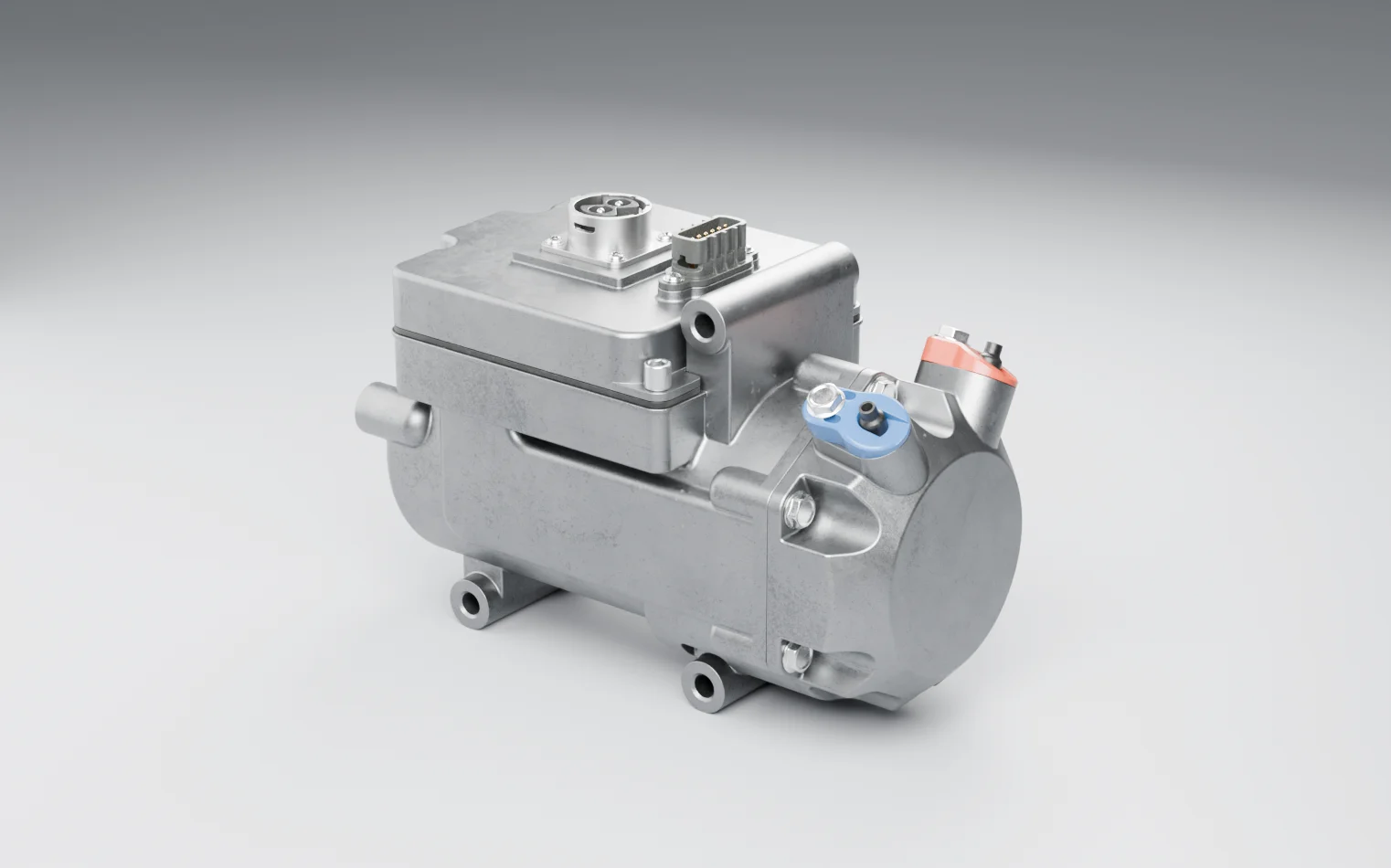
Raise the refrigerant in an electrified vehicle's air-conditioning circuit from evaporator pressure to condenser pressure using an electric motor rather than the engine's belt. Low-pressure vapour comes in through the suction port and leaves hot and at high pressure through the discharge port, and the compressor's speed — not a clutch — sets how much it pumps. The supply is the vehicle's high-voltage battery, converted for the motor by an inverter that integrated designs carry in the box on top of the housing; on many vehicles the same circuit also cools the traction battery, so the compressor can run with the vehicle parked, charging or apparently switched off. This is a vehicle part, not process plant, and carries no tags. The model is the exterior only: it does not show the motor, the inverter or the pumping mechanism, does not mark which connector carries high voltage, does not say which port is suction and which is discharge, and cannot tell you the refrigerant or the oil it was built for. Read all of those from the part number and the vehicle's high-voltage service information before working any case here.
Components
Compressor housing
The body of the compressor and its mounting lugs. It is the pressure boundary for the refrigerant and, in an electric compressor, encloses the motor as well as the pumping mechanism — the motor windings sit in the refrigerant and oil, which is why the oil has to be an electrical insulator. None of the internals are modelled.
Normally: Bolted to its mounting, sealed at every joint, and bonded to the vehicle body as the manufacturer specifies.
Electronics cover
The box on top of the housing and its lid. On integrated electric compressors this is where the inverter that drives the motor sits, and in many designs it is cooled by the refrigerant flowing through the compressor. The model shows only the outside of the box, so it cannot confirm what is inside.
Normally: Closed and fully bolted down on its seal, with nothing disturbed since it left the factory.
Cover seal
The gasket between the lid and the box. It keeps water, dust and road salt out of the electronics; a seal that has been disturbed or damaged is one way moisture reaches high-voltage parts.
Normally: Seated and compressed all the way round, with no gap at the lid.
Refrigerant ports (caps fitted)
Two capped ports at the end of the housing and a capped fitting on its side, shown with their transit caps on as the unit is supplied. The model does not label them, and the colours of the caps are not a reliable guide to which is suction and which is discharge. In service the line connections seal on O-rings, among the commonest leak points in any A/C circuit.
Normally: In service: lines made up on new seals with no oil staining. As modelled: caps on, and staying on until the lines are ready to fit.
Electrical connectors
The two connectors on the cover, one round and one rectangular. On electric compressors one carries the high-voltage supply to the inverter and the other low-voltage control and communication; the model does not say which is which, so both are treated as high-voltage until the vehicle's information shows otherwise.
Normally: Mated, latched and sealed, with any interlock in the high-voltage connector made.
Housing and cover bolting
The bolts that hold the housing sections together, clamp the lid to the box and retain the port fittings. The housing joints are pressure joints on a charged circuit.
Normally: All present and tight, with no oil weeping from the joints they clamp.
Operating states
Charged, high voltage off
The refrigerant circuit is sealed and holding a standing pressure set by the ambient temperature, never zero, and the high-voltage system is switched off. Switched off is not the same as isolated: until the vehicle's isolation procedure has been carried out and the absence of voltage proved, the connectors and the electronics are treated as live, and until a recovery machine has shown otherwise the circuit is treated as charged.
Normal operation
The inverter drives the motor at whatever speed the cooling demand calls for, and the compressor draws vapour from the evaporator and delivers it to the condenser. It does not depend on the engine, and on a hybrid it can run with the engine stopped. Where the circuit settles depends on the ambient temperature, the airflow, the speed and the charge, so a pressure means something only against the vehicle's own service data — and this model carries none.
Parked or charging
On many electrified vehicles the compressor can start with nobody in the vehicle — pre-conditioning the cabin or cooling the battery while it charges. It is quiet, there is no belt to see moving, and a vehicle that looks shut down can be running its air-conditioning. That is why the high-voltage system is isolated before work, not just switched off.
High voltage isolated
The vehicle's high-voltage system has been isolated by its own procedure — usually removing a service disconnect, waiting the stated time for stored energy to discharge, and proving the absence of voltage with a suitable tester — by someone trained and authorised for that vehicle. Only then are the connectors or the cover touched, and the isolation stays in place until the work is finished.
Recovered for service
With the high voltage isolated and the refrigerant recovered, never vented, the circuit can be opened. Open ports let in air and moisture, so caps go back on whenever a connection is left open. After repair the circuit is leak-tested, evacuated and charged by weight with the refrigerant and the oil the vehicle specifies — using equipment that will not carry conventional compressor oil into it.
Failure scenarios and safeguards
MOREPressure
The control system slows or stops the compressor and cooling falls until the pressure comes down; the cause is traced to the fan, the condenser or the charge.
Causes
- Condenser fan not running — a failed motor, relay or fuse, or a control fault
- Condenser face blocked by leaves, insects or road dirt
- Circuit overcharged with refrigerant or oil
- Air or another non-condensable gas left in the circuit by an incomplete evacuation
- A restriction on the high side — a blocked expansion valve, a saturated drier, a kinked line
How it develops
- 01Heat is not being rejected at the condenser fast enough, or flow is restricted downstream, so pressure builds on the high side and backs up to the discharge port.
- 02The compressor is pumping against a higher head, so the motor draws more current and the inverter in the box above it runs hotter.
- 03The high-pressure sensor reads the rise and the control system tells the inverter to slow the compressor or stop it.
- 04If the protection does not act, pressure climbs until something gives — the relief valve where fitted, otherwise the weakest joint on the high side.
Safeguards
High-pressure protection
A pressure sensor on the high side — on the vehicle's lines, not on this model — tells the control system that discharge pressure is rising, and the inverter slows the compressor or stops it before the circuit reaches a pressure its parts were not built to hold.
If it fails: The compressor keeps pumping against a rising head. The pressure relief valve, where one is fitted, becomes the only protection; where none is, the weakest joint on the high side is.
Condenser fan and airflow
The condenser fan keeps air moving across the condenser when the vehicle is not — at a standstill, in traffic, or parked and pre-conditioning. Rejecting heat at the condenser is what keeps discharge pressure down in the first place.
If it fails: Discharge pressure climbs whenever the vehicle is stationary, including while it is parked with nobody near it.
Pressure relief valve, where fitted
A spring-loaded valve on the high side that opens if discharge pressure rises past what the circuit can tolerate, venting refrigerant and oil to atmosphere and reseating as the pressure falls. It protects the hardware, not the people beside it. The model does not show whether this circuit has one.
If it fails: With no relief path, or one that does not lift, the pressure finds the weakest point instead — a hose, a port seal, a housing joint — and the release is uncontrolled.
Charge by weight to the vehicle specification
The circuit is charged with the quantity, refrigerant and oil the vehicle's label and service data specify, weighed in by a charging station rather than judged from gauges or topped up. An overcharge and an undercharge are both causes on this worksheet.
If it fails: The circuit carries too much refrigerant or oil, too little, or the wrong kind, and the deviations that follow start the first time the compressor runs.
Unmitigated: The relief valve dumps refrigerant and oil, or a seal or hose fails instead — on a vehicle that may be parked and pre-conditioning with nobody beside it, or with someone leaning in over a hot motor compartment.
LESSRefrigerant charge
The protection stops the compressor running on a low charge. The leak is found with a detector or dye and repaired, and the circuit is evacuated and charged by weight.
Causes
- O-rings at the line connections leaking
- A hose or line chafed or holed, or a condenser struck by road debris
- A housing joint weeping
- Undercharged at the last service, or topped up instead of recovered and charged by weight
How it develops
- 01Refrigerant escapes at a joint and carries oil out with it; an oily patch around a fitting is usually the first sign.
- 02Less refrigerant reaches the compressor, so there is less of it to cool the motor and, where the design uses it, the inverter — and less to bring the oil back.
- 03The low-pressure and temperature protection refuses to run the compressor or cuts its speed, and the vehicle logs a fault.
- 04Kept running starved, the motor and the inverter overheat and the internals lose lubrication until the compressor seizes or the electronics fail.
Safeguards
Low-pressure and temperature protection
The control system will not run the compressor, or reduces its speed, when the low-side pressure is too low or the electronics report too high a temperature — the usual result of a leaked charge. It protects the motor and inverter from running without the refrigerant that cools them and carries the oil back.
If it fails: The compressor runs starved: the electronics and the motor overheat, lubrication fails, and the next thing to happen is a seizure or an electrical fault rather than poor cooling.
Leak test after repair
Before it is charged, a repaired circuit is proved tight — a pressure or vacuum hold, then an electronic detector or dye check at the joints — so a leak is found in the workshop rather than as a slow loss of charge in service.
If it fails: The circuit is charged with a leak in it. The charge bleeds away until the low-pressure cut-out acts, or the compressor runs on whatever is left.
Charge by weight to the vehicle specification
The circuit is charged with the quantity, refrigerant and oil the vehicle's label and service data specify, weighed in by a charging station rather than judged from gauges or topped up. An overcharge and an undercharge are both causes on this worksheet.
If it fails: The circuit carries too much refrigerant or oil, too little, or the wrong kind, and the deviations that follow start the first time the compressor runs.
Unmitigated: The compressor seizes or its electronics fail, and on a vehicle whose battery is cooled by the same circuit, battery cooling goes with it. Debris from a failed compressor is carried round the circuit, so a new compressor alone does not end the repair.
OTHER THANLubricant
The insulation monitoring flags the fault before it is a hazard; the circuit is flushed to the manufacturer's procedure, or the compressor replaced, and recharged with the specified oil.
Causes
- Conventional compressor oil added, or left in the hoses of a charging station also used on belt-driven compressors
- The circuit topped up with a general-purpose oil or an oil-and-dye product not approved for electric compressors
- A replacement compressor fitted with the wrong oil fill, or the wrong compressor fitted
How it develops
- 01The wrong oil enters with the refrigerant and mixes through the circuit.
- 02It reaches the motor, whose windings sit in the refrigerant and oil, and lowers the insulation between the windings and the housing.
- 03The vehicle's insulation monitoring sees the fall and warns, restricts or disables high voltage.
Safeguards
Specified insulating oil and dedicated equipment
Only the oil the manufacturer specifies for the electric compressor goes into the circuit, and service equipment is either dedicated to electric compressors or flushed by its maker's procedure, so conventional compressor oil left in hoses or a charging station is not carried in with the refrigerant. In an electric compressor the oil is part of the motor's insulation.
If it fails: Conventional oil mixed into the circuit lowers the insulation between the motor windings and the housing, and the vehicle's isolation monitoring starts to see it.
Vehicle insulation monitoring
The vehicle continuously checks the insulation between its high-voltage system and the body, and warns or disables high voltage when that insulation falls. It turns a single insulation fault into a warning on the dashboard rather than a hazard.
If it fails: A degraded insulation goes unreported, and a second fault elsewhere in the high-voltage system can complete a path through the vehicle body.
Unmitigated: Insulation keeps falling unreported until a second fault in the high-voltage system completes a path through the vehicle body, or the motor fails electrically inside the housing.
OTHER THANHigh-voltage isolation
Isolation by the vehicle's procedure, with absence of voltage proved, means there is nothing live at the connector when it is touched.
Causes
- Work started with the vehicle switched off but its high-voltage system not isolated
- Isolation assumed because the vehicle was silent, or because someone else was believed to have done it
- Stored energy not given the stated time to discharge, or absence of voltage not proved
- The cover opened or a connector disturbed by someone not trained for high-voltage work
How it develops
- 01A connector on the compressor is unplugged or handled with the high-voltage system still live.
- 02The person is now in contact with, or close to, a high-voltage circuit; opening the cover exposes the inverter's connections and stored energy.
- 03A cover put back on a disturbed or damaged seal leaves a path for moisture into the electronics — a fault that appears weeks later as an insulation warning.
Safeguards
High-voltage isolation and proving dead
Before the connectors, the cover or anything electrical on the compressor is touched, the vehicle's high-voltage system is isolated by its own procedure, stored energy is given the stated time to discharge, and the absence of voltage is proved with a suitable tester — by someone trained and authorised to do it on that vehicle, using insulated gloves and tools.
If it fails: Someone works on a live high-voltage connection, and the result is electric shock or an arc flash at the face and hands.
Vehicle insulation monitoring
The vehicle continuously checks the insulation between its high-voltage system and the body, and warns or disables high voltage when that insulation falls. It turns a single insulation fault into a warning on the dashboard rather than a hazard.
If it fails: A degraded insulation goes unreported, and a second fault elsewhere in the high-voltage system can complete a path through the vehicle body.
Unmitigated: Electric shock or an arc flash to the hands and face of the person at the connector.
OTHER THANMaintenance procedure
Recovery before the circuit is opened leaves nothing behind the joint, eye and hand protection deal with the residue, and the work is done in a ventilated bay away from pits and ignition sources.
Causes
- Lines or the compressor removed without the refrigerant being recovered first
- Recovery stopped early, with liquid still trapped in part of the circuit
- A service coupler or valve core disturbed while the circuit is charged
- A joint loosened to relieve a sticking fitting, on a circuit assumed to be empty
How it develops
- 01A joint on a charged circuit is loosened. Behind it is the standing pressure of the whole circuit, not a small residue.
- 02Liquid refrigerant and oil jet from the joint and flash to vapour as they leave it, freezing whatever they touch — the fitting, the spanner, the hand holding it.
- 03The vapour is heavier than air and sinks, collecting under the vehicle and in any pit beneath it. Where it meets a flame, a heater or a hot engine part, R-1234yf can ignite and either refrigerant can break down into acid gas.
Safeguards
Recovery before the circuit is opened
Before any line, port or fitting is disturbed, the refrigerant is recovered with a recovery machine and the circuit confirmed at atmospheric pressure, by a technician qualified for vehicle air-conditioning work where the jurisdiction requires it. Recovered refrigerant is never vented.
If it fails: A charged circuit is opened: liquid refrigerant and oil spray from the joint and flash to vapour, at the hands and face of whoever is holding the spanner.
Eye and hand protection
Safety glasses or goggles, and gloves suited to refrigerant work, whenever the circuit is connected to, opened or charged. Liquid refrigerant flashing to vapour freezes skin and eye tissue on contact.
If it fails: A spray that would have been an inconvenience becomes a cold burn to the hands or an injury to the eye.
Ventilated bay, clear of pits and ignition sources
Refrigerant work is done in a ventilated bay, away from pits and below-ground spaces where refrigerant vapour — heavier than air — collects, and away from naked flames and hot work. R-1234yf is classed as mildly flammable, and both common vehicle refrigerants break down into toxic products, hydrogen fluoride among them, when they meet a flame or a very hot surface.
If it fails: Released vapour collects where people are working and displaces the air; where it reaches a flame, a heater or a hot exhaust part, R-1234yf can ignite and either refrigerant can decompose into acid gas.
Unmitigated: Cold burns to the hands and face and injury to the eyes from the spray, refrigerant vapour building up in a pit where someone is working, and — where it reaches a flame or a hot surface — fire or toxic decomposition products. The refrigerant itself is lost to atmosphere, which is what the recovery requirement exists to prevent.