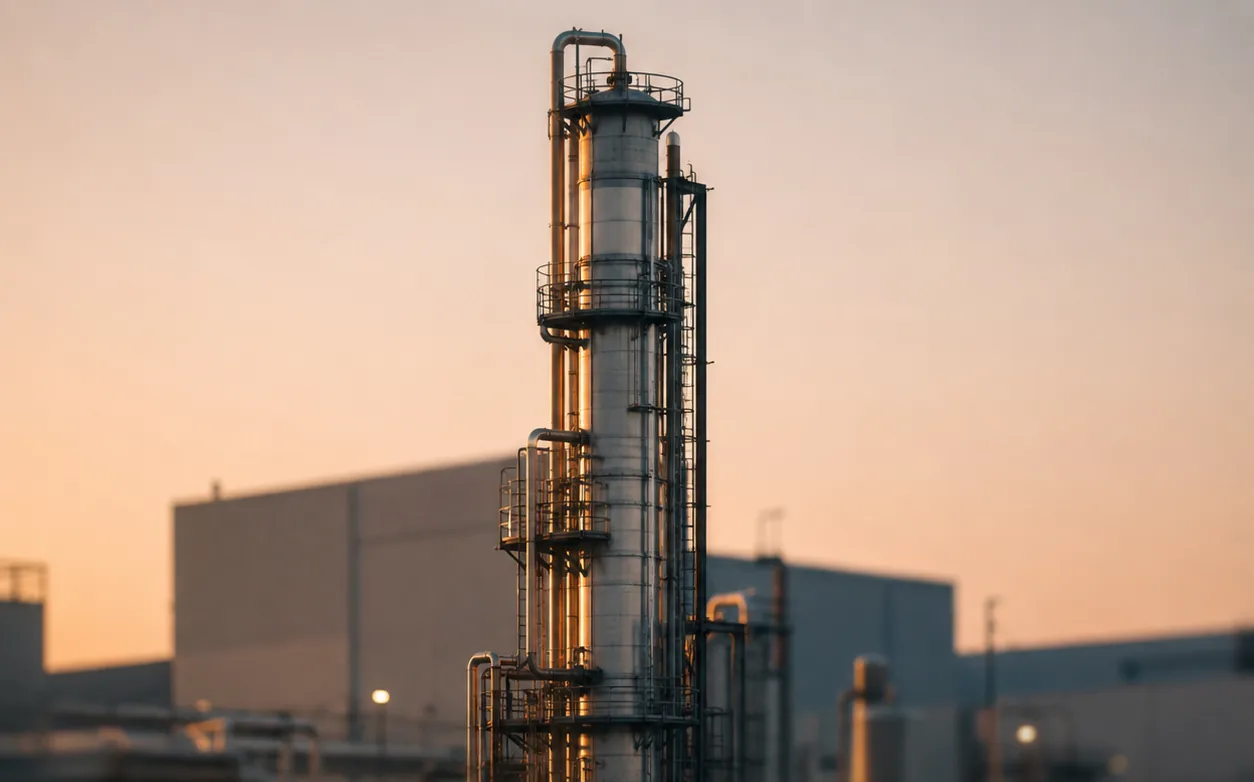
Water Bath Heater
Indirect fired heater that warms high-pressure gas ahead of a letdown station so pressure reduction does not form hydrates.
Normal operation. Burner modulates on bath temperature. Heat passes from fire tube to bath to process coil. Gas leaves the coil warm enough that letdown does not form hydrates.
Deviation library
Components
Explore the equipment
Heat high-pressure gas upstream of a pressure letdown station so that Joule-Thomson cooling across the choke does not drive the gas below its hydrate formation temperature. An indirect bath transfers heat from a fire tube to a process coil through a water bath, so flame never contacts the process stream.
Components
BurnerBNR-101
Fires into the submerged fire tube.
Normally: Modulating on bath temperature demand.
Fire tubeFT-101
Carries combustion gases through the bath, transferring heat to the water.
Normally: Fully submerged, wetted on all surfaces.
Water bathBATH-101
Intermediate heat transfer medium between fire tube and process coil.
Normally: At its normal operating level and temperature, covering the fire tube.
Process coilCOIL-101
Carries high-pressure process gas through the bath to pick up heat.
Normally: Submerged, gas leaving above hydrate formation temperature.
Low level switchLSL-101
Detects loss of bath level and trips the burner. Shown at an indicative height and mounting; the trip elevation on a real heater is set by its own datasheet.
Normally: Healthy, level above trip point.
Relief valvePSV-101
Protects the bath shell from overpressure.
Normally: Closed, set above normal operating pressure.
Exhaust stackSTK-101
Vents products of combustion to atmosphere.
Normally: Normal draft, no visible flame.
Operating states
Startup
Bath level confirmed, purge complete, pilot proven, burner brought to low fire while bath temperature climbs to setpoint.
Normal operation
Burner modulates on bath temperature. Heat passes from fire tube to bath to process coil. Gas leaves the coil warm enough that letdown does not form hydrates.
Shutdown
Burner secured, post-purge completed, bath allowed to cool. Process flow may continue until the coil outlet approaches hydrate conditions.
Failure scenarios and safeguards
LESSLevel
Low level switch trips the burner before the exposed fire tube reaches damaging temperature.
Causes
- Make-up water supply failure
- Bath boil-off not replaced
- Shell or drain leak
How it develops
- 01Bath level falls below normal operating range.
- 02Upper surface of the fire tube is no longer wetted.
- 03Exposed metal overheats; tube temperature climbs rapidly.
Safeguards
Low level tripLSL-101
Trips the burner before the fire tube can be exposed.
If it fails: Fire tube runs dry, overheats and may rupture into the bath.
High temperature tripTSH-101
Cuts fuel to the burner on high bath temperature.
If it fails: Bath boils off, accelerating level loss.
Unmitigated: Fire tube overheats and ruptures, releasing combustion products into the bath and potentially failing the shell.
NOFlow
High bath temperature cuts the burner, and the relief valve protects the coil against thermal expansion of trapped gas.
Causes
- Upstream isolation closed in error
- Blockage or hydrate plug in the coil
- Downstream trip closing the letdown valve
How it develops
- 01Process gas stops moving through the coil.
- 02Stagnant gas absorbs heat with nowhere to carry it; coil metal temperature rises.
- 03Trapped gas expands and coil pressure climbs toward relief setpoint.
Safeguards
High temperature tripTSH-101
Cuts fuel to the burner on high bath temperature.
If it fails: Bath boils off, accelerating level loss.
Pressure reliefPSV-101
Relieves bath overpressure to a safe location.
If it fails: Bath shell is overpressured beyond its design rating.
Unmitigated: Overheated coil loses strength while pressurised, risking rupture of a high-pressure gas line inside the bath.
MORETemperature
High temperature trip cuts fuel; relief protects the shell and the low level trip provides a second line of defence.
Causes
- Temperature control loop fails with burner at high fire
- Sensor reads low, so control keeps calling for heat
- Reduced process duty with unchanged firing rate
How it develops
- 01Temperature control never reaches setpoint, so the burner stays at high fire.
- 02Bath approaches boiling; level begins to fall through evaporation.
- 03Steam generation raises bath pressure and accelerates level loss.
Safeguards
High temperature tripTSH-101
Cuts fuel to the burner on high bath temperature.
If it fails: Bath boils off, accelerating level loss.
Pressure reliefPSV-101
Relieves bath overpressure to a safe location.
If it fails: Bath shell is overpressured beyond its design rating.
Low level tripLSL-101
Trips the burner before the fire tube can be exposed.
If it fails: Fire tube runs dry, overheats and may rupture into the bath.
Unmitigated: Bath boils dry, exposing the fire tube, with the shell overpressured by steam at the same time.
NOCombustion
Flame supervision closes the fuel valve on loss of flame and forces a full purge before any re-light attempt.
Causes
- Fuel gas supply interruption
- Pilot extinguished by draught
- Fuel pressure outside burner turndown
How it develops
- 01Flame is lost while the fuel valve is still open.
- 02Unburned fuel gas accumulates inside the fire tube.
- 03A delayed re-ignition ignites the accumulated volume.
Safeguards
Flame supervisionBMS-101
Detects loss of flame and closes the fuel valve, forcing a purge before re-light.
If it fails: Unburned fuel accumulates in the fire tube and ignites on the next attempt.
Unmitigated: Accumulated fuel ignites as an explosion inside the fire tube, deforming the tube and potentially the shell.
OTHER THANContainment
Gas detection alarms and the operator shuts in the unit; relief protects the bath from the pressure of the released gas.
Causes
- Internal corrosion or erosion of the coil
- Weld or fitting failure
- Thermal fatigue from repeated cycling
How it develops
- 01High-pressure process gas escapes from the coil into the water bath.
- 02Gas bubbles up through the bath toward the open surface.
- 03A flammable cloud forms at the bath surface, near the burner front.
Safeguards
Gas detectionGD-101
Detects hydrocarbon around the bath surface and alarms in the control room.
If it fails: A flammable cloud reaches an ignition source undetected.
Pressure reliefPSV-101
Relieves bath overpressure to a safe location.
If it fails: Bath shell is overpressured beyond its design rating.
Unmitigated: Process gas reaches the burner and ignites at the bath surface, with the coil still feeding the release.