Emergency Shower and Eyewash
A combination emergency shower and eyewash, showing no water when it is needed, a weak eyewash, blocked access, water too cold or hot to stand under and stagnant supply.
Shower in use. The casualty pulls the handle and stands under the head. The valve stays open, so both hands are free to strip off contaminated clothing while the water runs over the whole body for as long as the first-aid guidance for the chemical says.
Deviation library
Components
Explore the equipment
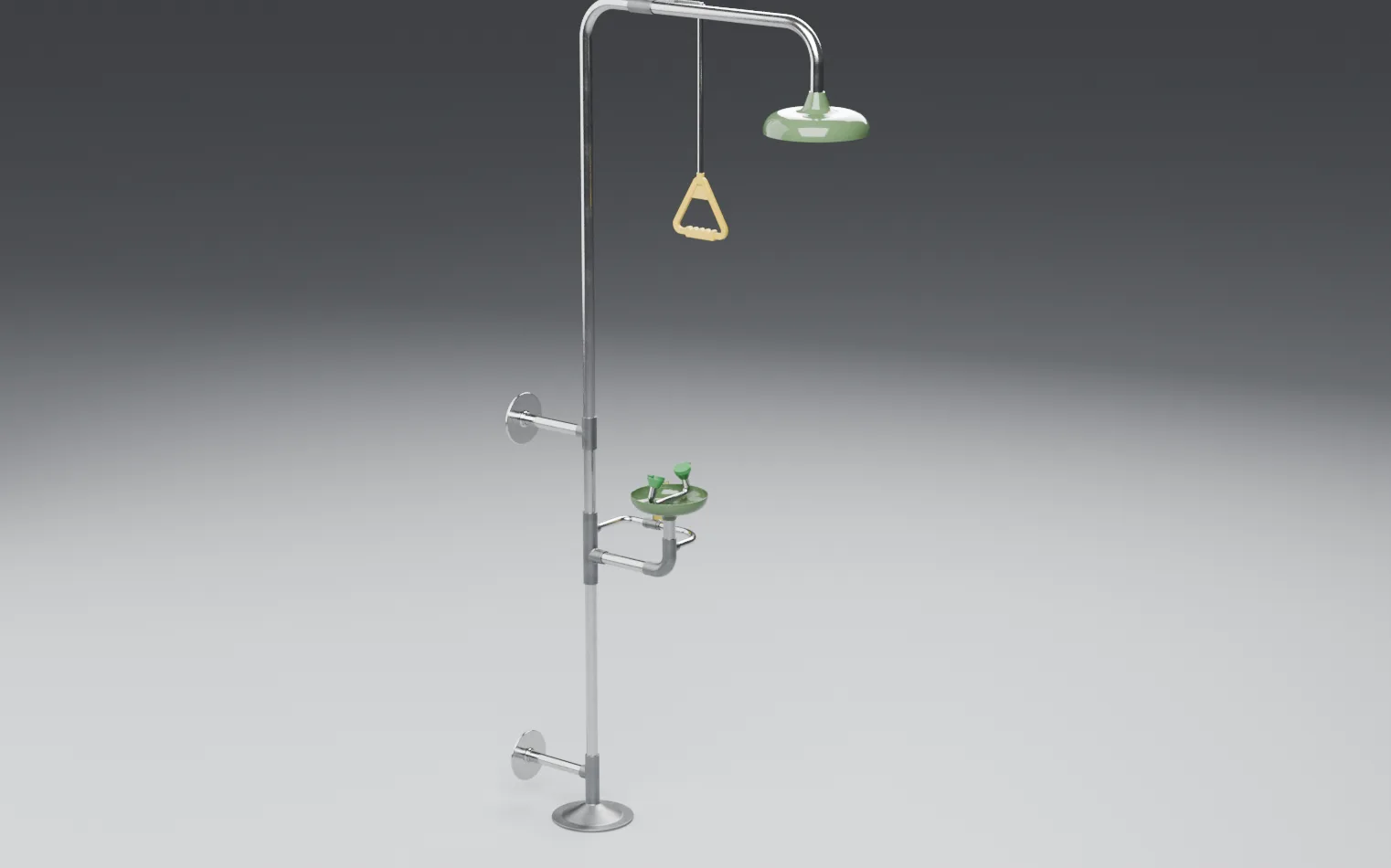
Wash a hazardous chemical off a person's body and out of their eyes in the first seconds after it reaches them, before it does lasting harm. Pulling the triangular handle opens the shower valve and drenches the whole body; pushing the eyewash handle lifts the dust caps and sends two streams across the bowl, one for each eye. Both valves stay open once operated, so the casualty's hands are free to hold their eyes open and take off contaminated clothing. Speed matters more than anything else: the unit has to be close to the hazard, on the same level, unobstructed and found without thinking. This is first-aid equipment, not process plant, and carries no tags. The model is the unit itself: it does not include the water supply, any tempering valve or the water temperature, a drain, a sign, an activation alarm or freeze protection, and two flanged side branches on the stand are modelled without saying which, if either, carries the supply. How long to flush for, and the flow and temperature the unit must deliver, come from the standard it is installed to and the safety data sheet of the chemical.
Components
Shower head
The deluge head on the arm above the user. It spreads a large flow of water over the whole body at once, which a domestic shower cannot do.
Normally: Clean, unblocked and pointing straight down over the standing position.
Shower valve
The valve on the shower arm, opened by the pull rod. It stays open once pulled and is closed again by pushing the rod back up.
Normally: Closed, free to operate, and not leaking.
Pull rod and handle
The rod and triangular handle that hang from the shower valve, so the shower can be opened by someone who cannot see.
Normally: Hanging free within reach of the standing position, not tied up or hooked out of the way.
Eyewash bowl
The bowl at waist height that the casualty leans over. It catches the water from the heads and carries it away.
Normally: Clean and empty, with nothing stored in it.
Eyewash heads and dust caps
The two spray heads in the bowl, one for each eye, under caps that keep dust and debris out and are pushed off by the water when the eyewash is opened.
Normally: Capped, clean, and both heads delivering an even stream when tested.
Eyewash valve and push handle
The stay-open valve under the bowl, opened by the flag-shaped push handle, and the pipework that feeds the heads.
Normally: Closed, free to operate with one push, and not leaking.
Stand pipe and base
The vertical pipe that carries water up to both the eyewash and the shower, its floor flange and the two flanged side branches. A leak or a closed supply anywhere below the eyewash takes out both.
Normally: Firmly fixed to the floor, full of water and connected to a supply that is open.
Operating states
Standby
Both valves are closed, the pipework is full of water at the supply's temperature, the caps are on the eyewash heads and the area around the unit is clear. Nothing happens until someone needs it, which is why it is tested on a schedule rather than trusted.
Shower in use
The casualty pulls the handle and stands under the head. The valve stays open, so both hands are free to strip off contaminated clothing while the water runs over the whole body for as long as the first-aid guidance for the chemical says.
Eyewash in use
The casualty pushes the handle, the caps lift off and two streams meet over the bowl. They lean in and hold their eyelids open with their fingers, rolling the eyes, while someone else calls for help.
Activation test
The shower and the eyewash are run at the interval the standard and local rules set, to confirm both deliver water, to flush out water that has stood in the pipe, and to check the caps come off and the streams are even. The test is recorded on a tag or log at the unit.
Failure scenarios and safeguards
NOWater flow
The closed supply or seized valve is found at the activation test and put right before the unit is needed.
Causes
- Supply isolation valve closed for maintenance elsewhere and not reopened
- Supply pipe frozen on an outdoor unit
- Valve seized from never being operated
- Supply disconnected or the pipe damaged
How it develops
- 01The casualty pulls the handle or pushes the flag and the valve opens.
- 02Nothing comes out, from the shower or the eyewash, because both are fed by the same stand pipe.
- 03The casualty, often unable to see, has to find another water source while the chemical keeps working.
Safeguards
Regular activation test
Both the shower and the eyewash are run at the interval set by the standard and local rules, and the test is logged at the unit.
If it fails: A closed supply, a blocked head or stagnant water is found by the casualty instead of the tester.
Supply valve secured open
Any isolation valve on the supply is locked or labelled open, and closing it for maintenance is controlled under a permit with the unit marked out of service and another provided.
If it fails: The supply is closed for work elsewhere and nobody tells the people relying on the unit.
Activation alarm, where fitted
A flow switch on the unit sounds an alarm or alerts a control room when it is used, so help arrives for someone who may be alone.
If it fails: A lone worker flushes their eyes and nobody knows they are hurt.
Unmitigated: A chemical burn or eye injury made far worse, possibly permanent sight loss, while the casualty searches for water.
LESSEyewash flow
The weak pattern is seen at the test and the heads or strainer cleaned.
Causes
- Low supply pressure
- Heads partly blocked by scale or debris
- Dust caps missing, letting dirt into the heads, or stuck on
- Strainer in the eyewash feed blocked
How it develops
- 01The streams are weak, uneven or do not meet over the bowl.
- 02One eye is flushed and the other is not, or the casualty has to lean so far into the bowl that they cannot hold their eyes open.
Safeguards
Regular activation test
Both the shower and the eyewash are run at the interval set by the standard and local rules, and the test is logged at the unit.
If it fails: A closed supply, a blocked head or stagnant water is found by the casualty instead of the tester.
Periodic inspection against the standard
A competent person checks the unit against the standard it was installed to — flow, spray pattern, valve operation, height and the water temperature at the outlets — at the interval that standard sets.
If it fails: A unit that runs water but no longer delivers what a casualty needs goes unnoticed.
Unmitigated: An eye that is not properly flushed, and an injury that a working eyewash would have limited.
OTHER THANAccess
Workplace inspections keep the area clear, and the unit's position is reviewed whenever the layout or the chemicals change.
Causes
- Pallets, drums or equipment stored in front of the unit
- Pull rod hooked up out of the way, or things stored in the bowl
- Unit moved behind a door or round a corner during a layout change
- New chemical handling started away from the unit
How it develops
- 01The handle is out of reach or the bowl is full, and the casualty, often with their eyes shut, cannot find or operate the unit.
- 02Seconds pass while they or a colleague clear the way.
Safeguards
Located close to the hazard, on the same level
The unit is placed where someone splashed by the chemical can reach it in seconds without climbing stairs, opening doors or crossing other hazards, and the hazard assessment says why it is where it is.
If it fails: The casualty loses the first seconds that decide how bad the injury is.
Access kept clear and the unit signed
The floor in front of the unit is kept clear, it is lit and marked with a sign that can be seen from the work area, and nothing is stored in the bowl or hung from the pull rod.
If it fails: A casualty who cannot see has to find a unit hidden behind pallets, or one that has become a shelf.
Users trained to use it
People who work with the chemical are shown where the unit is and practise using it: pull the handle, step in, strip contaminated clothing, hold the eyes open, keep flushing.
If it fails: The casualty hesitates, or stops flushing as soon as the pain eases.
Unmitigated: A delay in the first seconds after exposure, when it matters most.
OTHER THANWater temperature
The water temperature is checked at inspection and tempering keeps it tolerable.
Causes
- Cold supply in winter, or an outdoor unit with no tempering
- Supply pipe running in the sun, or past a hot process line
- Tempering valve failed or set wrongly
How it develops
- 01The water is uncomfortably cold, or hot from the pipe it has stood in.
- 02The casualty steps out of the shower or pulls away from the eyewash long before the flush is complete.
Safeguards
Tempered water, where required
Where the supply could be too cold or too hot to stand under, a tempering valve, insulation, trace heating or shading keeps the water at a temperature a casualty will tolerate for the whole flush.
If it fails: Cold water makes the casualty stop early; hot water from a sun-heated pipe scalds.
Periodic inspection against the standard
A competent person checks the unit against the standard it was installed to — flow, spray pattern, valve operation, height and the water temperature at the outlets — at the interval that standard sets.
If it fails: A unit that runs water but no longer delivers what a casualty needs goes unnoticed.
Users trained to use it
People who work with the chemical are shown where the unit is and practise using it: pull the handle, step in, strip contaminated clothing, hold the eyes open, keep flushing.
If it fails: The casualty hesitates, or stops flushing as soon as the pain eases.
Unmitigated: A flush cut short, leaving chemical on the skin or in the eyes, or a scald from hot standing water.
OTHER THANWater quality
Running the unit on schedule flushes the standing water out before it builds up.
Causes
- Unit not run for weeks, so water stands in the pipe
- Warm standing water in a dead leg
- Debris in the heads with the dust caps missing
How it develops
- 01Water stands in the stand pipe and its branches, warming and growing bacteria and sediment.
- 02The first water out is discoloured, and the shower turns it into a spray the casualty breathes in.
Safeguards
Regular activation test
Both the shower and the eyewash are run at the interval set by the standard and local rules, and the test is logged at the unit.
If it fails: A closed supply, a blocked head or stagnant water is found by the casualty instead of the tester.
Periodic inspection against the standard
A competent person checks the unit against the standard it was installed to — flow, spray pattern, valve operation, height and the water temperature at the outlets — at the interval that standard sets.
If it fails: A unit that runs water but no longer delivers what a casualty needs goes unnoticed.
Unmitigated: Dirty water in an injured eye, and exposure to waterborne bacteria from the spray.