Engine Air Filter Housing
An engine air filter housing, showing a blocked element, unfiltered air bypassing it, water in the intake and an engine run with the intake open.
Normal operation. The engine draws air through the inlet, the element and the outlet. As the element loads with dust its restriction rises slowly — invisible from outside, which is why elements are changed by interval or by a restriction indicator rather than by eye. How quickly depends on how dusty the roads or the site are.
Deviation library
Components
Explore the equipment
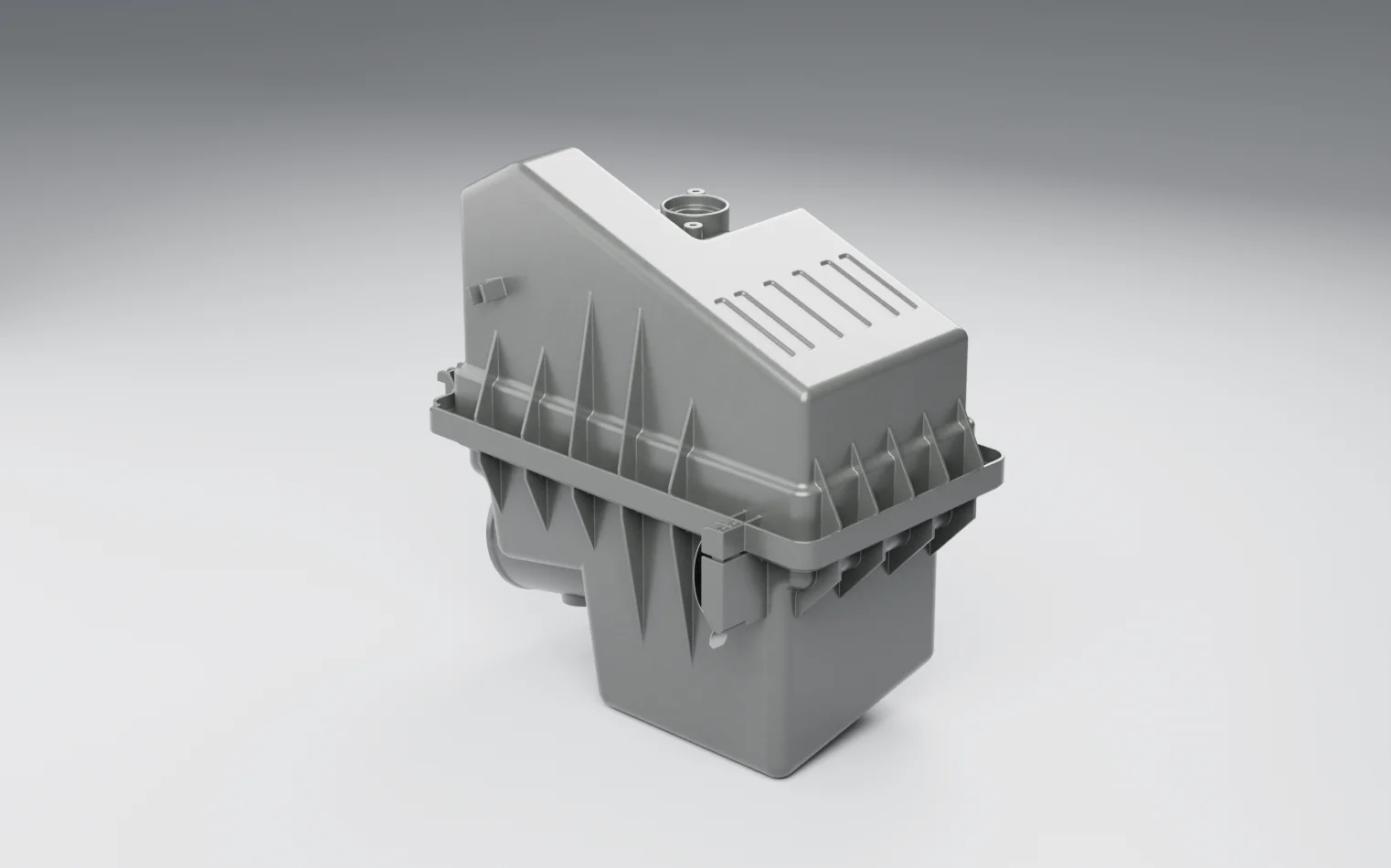
Make every bit of air an engine breathes pass through a filter element first, and keep water and debris out of the intake. Air enters the lower housing, passes through the element clamped between the two halves, and leaves through the cover's outlet towards the engine — or the turbocharger, where there is one. The housing's whole job is to leave no other way in: an element that is not seated, a cover that is not clipped or a crack in either half lets unfiltered air go round the element instead of through it. It is a vehicle part, not process plant, and carries no tags. The model is the two halves of the housing and its latch clips; it does not include the filter element, the intake ducting, any airflow sensor or any drain or dust valve, and it cannot tell you the engine it belongs to or that engine's service interval. Read those from the vehicle's service information.
Components
Lower housing
The lower half of the box, which takes in the unfiltered air and holds the filter element's sealing edge. Dust and water that enter the intake collect here, on the dirty side of the element.
Normally: Intact, clean on its sealing face and firmly mounted, with its inlet clear.
Cover and outlet
The upper half of the box, carrying the outlet to the engine. Everything on its inside is the clean side: anything that reaches it reaches the engine.
Normally: Seated on the element's seal all the way round and clipped down, with the outlet ducting secure.
Latch clips
The metal clips that pull the cover down onto the lower housing and clamp the element's seal between them. A clip left open, or one that has lost its spring, leaves a gap for unfiltered air.
Normally: All closed and holding the two halves tight together.
Operating states
Clean element
A new or recently changed element, correctly seated, with the cover clipped down. Air passes through with little restriction and the engine gets the airflow it was designed for.
Normal operation
The engine draws air through the inlet, the element and the outlet. As the element loads with dust its restriction rises slowly — invisible from outside, which is why elements are changed by interval or by a restriction indicator rather than by eye. How quickly depends on how dusty the roads or the site are.
Wading or heavy rain
Water reaching the intake — from deep standing water, spray or driving rain — is the one load the housing cannot filter out. Small amounts drain or settle in the lower housing; a slug of water drawn into the engine is a different case entirely.
Element change
Engine off. The clips are released, the cover lifted, the old element taken out without knocking its dust into the clean side, the housing wiped, the new element seated on its seal and the cover clipped down with every latch closed.
Failure scenarios and safeguards
LESSAirflow
The element is changed when it is due, and the engine keeps its airflow.
Causes
- Element left in past its interval, or loaded fast on dusty duty
- Inlet blocked by leaves, snow or debris
- Element soaked by water and swollen
How it develops
- 01Dust builds up on the dirty side of the element and the restriction rises.
- 02Less air reaches the engine; it loses power and, on many engines, the control system logs an airflow fault.
- 03Pushed far enough, the element collapses or tears under the pressure difference and stops filtering at all.
Safeguards
Element change by interval or indicator
The element is changed at the interval the vehicle specifies, sooner on dusty duty, or when a restriction indicator — where the vehicle has one — says it is due, rather than when it looks dirty.
If it fails: The element loads until it restricts the engine's air, or until it tears and lets dust through.
Unmitigated: Loss of power, and an element that eventually tears and turns this into the next deviation.
OTHER THANAir path
The seal and the latches are checked after every element change, and no dust reaches the clean side.
Causes
- Element not seated on its seal after a change
- A latch clip left open, or one that has lost its spring
- A crack in the cover or the lower housing
- The wrong element, sealing loosely or on the wrong face
How it develops
- 01A gap opens between the cover and the lower housing, or round the element's seal.
- 02Unfiltered air takes the easy path round the element and into the clean side, carrying fine dust with it.
- 03The dust reaches the engine — and the turbocharger's compressor wheel where there is one — and wears them from the inside.
Safeguards
Element seated and every latch closed
After any work on the housing, the element is checked seated on its seal all the way round, the cover is pressed down evenly and every clip is closed, and the ducting on the outlet is checked secure.
If it fails: A gap at the seal or an open clip lets unfiltered air into the clean side.
Correct element for the housing
Only the element specified for this housing is fitted, so its seal matches the sealing faces.
If it fails: An element that fits loosely, or seals on the wrong face, lets air go round it.
Unmitigated: Abrasive wear of the engine's cylinders, rings and turbocharger over weeks or months, found only as oil consumption, smoke or a failed turbocharger.
AS WELL ASWater
The vehicle stays within its wading limit, and any water that reaches the housing stays on the dirty side.
Causes
- Driving through water deeper than the vehicle allows
- A bow wave from another vehicle, or flood water
- A blocked drain in the housing, where it has one
How it develops
- 01Water enters the inlet and collects in the lower housing, soaking the element.
- 02Enough of it, drawn through, reaches the engine's cylinders.
- 03Water does not compress. A cylinder that fills with it stops the piston, and the engine stalls with bent internal parts.
Safeguards
Wading limits and intake height
The vehicle is not driven through water deeper than its manufacturer allows, and where it is used in water routinely, the intake is raised above it — a snorkel — rather than relying on the housing.
If it fails: Water reaches the intake in a quantity the housing cannot hold.
Element change by interval or indicator
The element is changed at the interval the vehicle specifies, sooner on dusty duty, or when a restriction indicator — where the vehicle has one — says it is due, rather than when it looks dirty.
If it fails: The element loads until it restricts the engine's air, or until it tears and lets dust through.
Unmitigated: A hydraulically locked engine — stalled, with bent connecting rods — often in water, with the vehicle stranded where it stopped.
OTHER THANMaintenance procedure
The engine stays off until the housing is closed and every latch checked.
Causes
- The engine started to check something with the cover off or the ducting disconnected
- A rag or a tool left in the housing during an element change
How it develops
- 01The engine runs with nothing between the open intake and the air around it.
- 02Whatever is near the opening is drawn in — dirt, a rag, a tool, and on a turbocharged engine the suction at the inlet is strong enough to pull in a hand.
Safeguards
Engine off before the housing is opened
The engine is stopped and the start system made safe before the cover is lifted or the ducting disconnected, and it is not run with the intake open.
If it fails: A running engine draws in whatever is near the open intake — dirt, a rag, a tool or a hand.
Element seated and every latch closed
After any work on the housing, the element is checked seated on its seal all the way round, the cover is pressed down evenly and every clip is closed, and the ducting on the outlet is checked secure.
If it fails: A gap at the seal or an open clip lets unfiltered air into the clean side.
Unmitigated: A destroyed turbocharger or engine damage from a drawn-in object, or a hand injured at the turbocharger inlet.