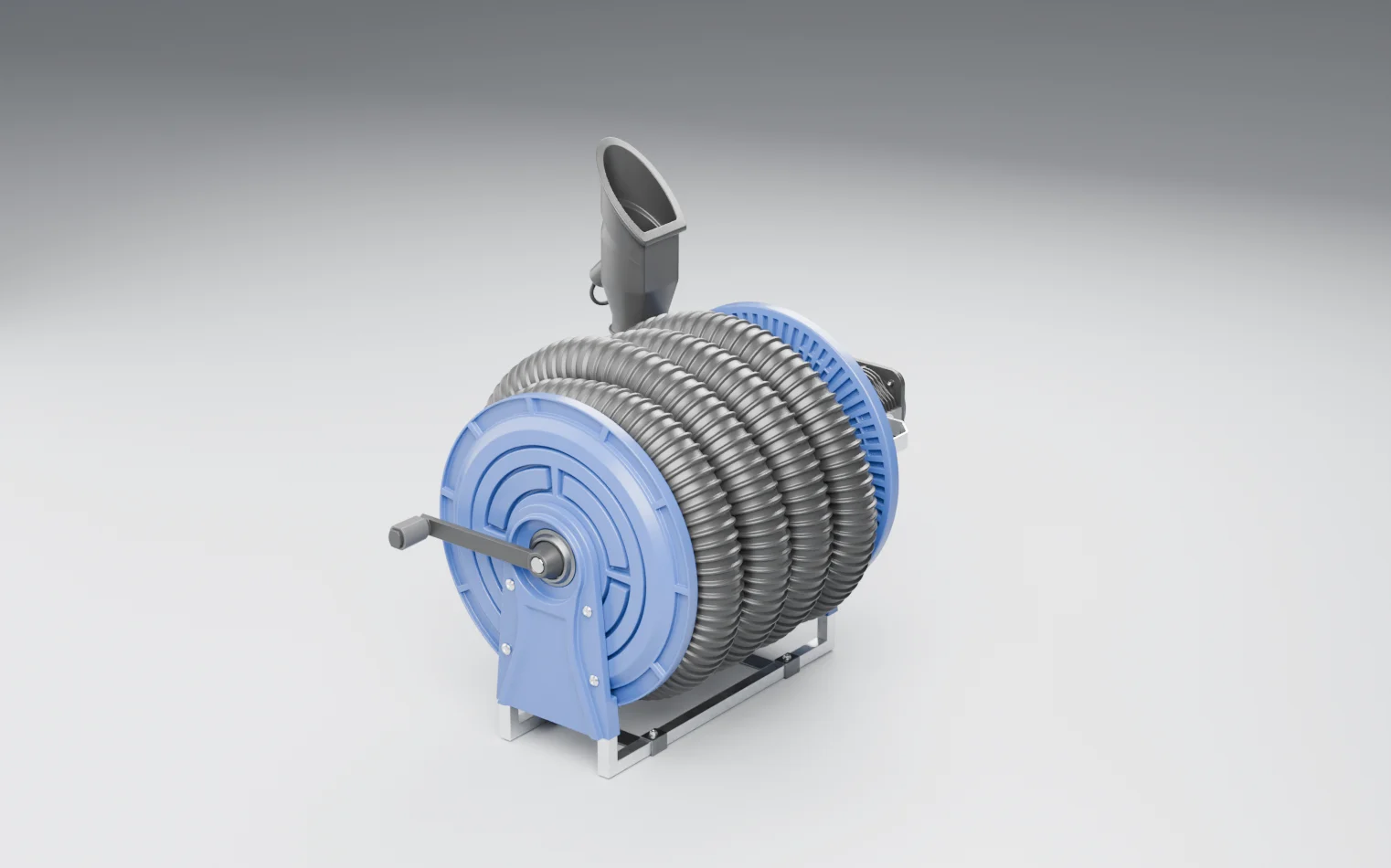
Exhaust Extraction Hose Reel
A workshop exhaust extraction hose reel, showing no extraction, poor capture at the tailpipe, a split hose, heat and a vehicle moved with the nozzle on.
In use. The hose is drawn out, the nozzle is over the tailpipe and the extraction fan is running before the engine is started. Exhaust leaves the tailpipe straight into the nozzle and goes out through the hub and duct, and the air around the vehicle stays clear.
Deviation library
Components
Explore the equipment
Capture a running vehicle's exhaust at the tailpipe and carry it out of the workshop before it reaches the air people breathe. The nozzle fits over the tailpipe, the hose carries the exhaust to the reel, and the hub connects the reel to a fixed duct and an extraction fan that discharge it outside. Engine exhaust is the hazard: carbon monoxide, which cannot be seen or smelt and is the main danger from petrol engines, nitrogen oxides, and diesel engine exhaust as a whole, which is classed as carcinogenic to humans. Local extraction at the tailpipe is what controls it; general ventilation alone does not. This is workshop equipment, not process plant, and carries no tags. The model is the reel: it does not include the extraction fan, the duct, any airflow indicator or any carbon monoxide detection, it is wound by hand rather than by a spring or motor, and it cannot tell you the extraction rate it was designed for. Read those from the system's design and its last examination record.
Components
Hose and tailpipe nozzle
The flexible extraction hose with the nozzle on its end that fits over the tailpipe, and the clamp that fixes it to the drum. The nozzle's fit on the tailpipe decides how much of the exhaust is captured; any split in the hose lets exhaust out and air in before it reaches the fan.
Normally: Unbroken along its length, the nozzle sized for the tailpipe and fully over it, the hose run clear of wheels and walkways.
Reel drum
The drum the hose winds onto, with its side plates and axle. It stores the hose off the floor when it is not in use.
Normally: Turning freely, with the hose wound neatly between its side plates.
Hub and duct outlet
The rotating joint at the centre of the reel, through which the extracted exhaust leaves the hose and passes into the fixed duct to the fan. A leak or a disconnection here vents exhaust into the workshop at the reel itself.
Normally: Sealed and connected to the duct, turning with the drum without leaking.
Crank handle
The handle that winds the hose back onto the drum. The reel is wound by hand; there is no spring or motor in the model.
Normally: Secure on its shaft and folded clear when the hose is in use.
Frame and mounting
The steel frame and feet that carry the reel, and the fixings that hold it to the floor, wall or ceiling. It has to resist the pull on the hose if a vehicle moves with the nozzle still on.
Normally: Firmly fixed, square and undamaged.
Operating states
Stowed
The hose is wound on the drum and the nozzle parked off the floor. Nothing is running, and the bay relies on general ventilation alone — which is why no engine is started in it until a nozzle is on the tailpipe.
In use
The hose is drawn out, the nozzle is over the tailpipe and the extraction fan is running before the engine is started. Exhaust leaves the tailpipe straight into the nozzle and goes out through the hub and duct, and the air around the vehicle stays clear.
Running at speed
A test, a regeneration or a diagnostic run raises engine speed, and with it the exhaust flow and its temperature. The nozzle and the end of the hose get hot, and a nozzle that only just fits at idle can stop capturing everything.
Examination and test
The extraction system is examined and tested by a competent person at the interval its design and local rules require, confirming that it still captures and removes the exhaust at the rate it was designed for. Between examinations, the hose and nozzle are checked by the people who use them.
Failure scenarios and safeguards
NOExtraction flow
The airflow indication shows the fan is not running before the engine starts, or the detector alarms, and the engine is stopped.
Causes
- Fan not switched on, or switched off at the end of a job while another vehicle is still running
- Fan failed, or its drive belt broken
- Duct damper closed, or the duct disconnected from the hub
- Duct or hub blocked
How it develops
- 01The nozzle is on the tailpipe, but nothing is drawing the exhaust away.
- 02Exhaust fills the hose and spills back out round the nozzle, and from any leak at the hub.
- 03It spreads through the bay. Carbon monoxide gives no warning by sight or smell.
Safeguards
Nozzle on and fan running before the engine starts
The nozzle goes over the tailpipe and the extraction fan is switched on before the engine is started, every time, and stays on until the engine has stopped.
If it fails: The first seconds of exhaust, and every run where someone forgets, go straight into the workshop.
Airflow indication, where fitted
An airflow indicator or a fan-running light at the point of use shows that the system is extracting, so a failed or switched-off fan is noticed at the vehicle rather than by the people breathing the result.
If it fails: The nozzle is on, the fan is off, and nothing says so.
Carbon monoxide detection, where fitted
Fixed carbon monoxide detection in the workshop alarms if exhaust is escaping, catching the failures that people cannot smell.
If it fails: Carbon monoxide builds up without warning, and the first sign is headache, dizziness or worse.
Unmitigated: Carbon monoxide poisoning of the people in the workshop — headache, dizziness, collapse — and repeated exposure to diesel exhaust.
LESSCapture at the tailpipe
The nozzle matches the tailpipe and is checked on, and the exhaust is captured.
Causes
- Nozzle too large or too small for the tailpipe, or not pushed fully on
- Nozzle slipped off as the engine shook at idle or speed
- One nozzle on a vehicle with two tailpipes
- Hose kinked or crushed, reducing the suction at the nozzle
How it develops
- 01Part of the exhaust leaves the tailpipe outside the nozzle.
- 02It disperses at floor and breathing height round the back of the vehicle, where the technician is working.
Safeguards
Correct nozzle for the tailpipe
A nozzle sized for the tailpipe, pushed fully on, and one nozzle per tailpipe where the vehicle has more than one.
If it fails: Some of the exhaust goes round the nozzle instead of into it.
Hose and nozzle checks before use
The hose and nozzle are looked over before use for splits, crush damage and loose clamps, and damaged hose is taken out of use rather than taped.
If it fails: A split hose leaks exhaust at floor level, and loses suction at the nozzle.
Carbon monoxide detection, where fitted
Fixed carbon monoxide detection in the workshop alarms if exhaust is escaping, catching the failures that people cannot smell.
If it fails: Carbon monoxide builds up without warning, and the first sign is headache, dizziness or worse.
Unmitigated: A steady exposure for whoever works behind the vehicle, worst when the engine is run at speed.
OTHER THANHose integrity
The damage is seen at the pre-use check and the hose replaced before it is used again.
Causes
- Hose run over by a wheel
- Hose dragged across the floor or a sharp edge
- Hose damaged by heat at the nozzle end
- Clamp at the drum or the nozzle loosened
How it develops
- 01The hose splits or is crushed partway along its length.
- 02Air is drawn in at the split instead of at the nozzle, so suction at the tailpipe falls; with the fan weak or off, exhaust leaks out of the split at floor level.
Safeguards
Hose and nozzle checks before use
The hose and nozzle are looked over before use for splits, crush damage and loose clamps, and damaged hose is taken out of use rather than taped.
If it fails: A split hose leaks exhaust at floor level, and loses suction at the nozzle.
Periodic examination and test
The whole extraction system — nozzle, hose, reel, duct and fan — is examined and tested by a competent person at the interval its design and local rules require, and the record says whether it still performs as designed.
If it fails: The system's performance decays unnoticed until it is no longer controlling the exposure.
Nozzle off before the vehicle moves
The nozzle is taken off and the hose returned to the reel before a vehicle is driven out of the bay, and the hose is never routed under a wheel.
If it fails: A moving vehicle drags the hose, the nozzle and possibly the reel with it.
Unmitigated: An extraction system that looks connected and is not controlling the exposure.
MORETemperature
Heat-resistant gloves are used, and heat-damaged hose is found and replaced.
Causes
- Long runs at high engine speed
- A filter regeneration or a test cycle
- A nozzle and hose not rated for the vehicle's exhaust
How it develops
- 01The nozzle and the first length of hose heat up.
- 02The hose softens or degrades near the nozzle, and the nozzle is hot enough to burn a hand.
Safeguards
Heat-resistant gloves for the nozzle
The nozzle is taken off a hot tailpipe with heat-resistant gloves, or once the exhaust has cooled.
If it fails: A burn to the hand from the nozzle or the tailpipe.
Hose and nozzle checks before use
The hose and nozzle are looked over before use for splits, crush damage and loose clamps, and damaged hose is taken out of use rather than taped.
If it fails: A split hose leaks exhaust at floor level, and loses suction at the nozzle.
Unmitigated: Burns to the hands, and a hose that fails at its hot end.
OTHER THANOperating procedure
The nozzle comes off and the hose is reeled in before the vehicle moves.
Causes
- Vehicle driven out of the bay with the nozzle still on the tailpipe
- Hose left under a wheel when the vehicle is moved
How it develops
- 01The moving vehicle pulls the hose taut.
- 02The hose stretches and tears, or the nozzle is ripped off and flung, and the pull reaches the drum and the frame fixings.
Safeguards
Nozzle off before the vehicle moves
The nozzle is taken off and the hose returned to the reel before a vehicle is driven out of the bay, and the hose is never routed under a wheel.
If it fails: A moving vehicle drags the hose, the nozzle and possibly the reel with it.
Unmitigated: A torn hose, a nozzle thrown across the bay, a damaged reel or one pulled from its fixings — and a bay without extraction until it is repaired.