Lever-Released Fire Suppression Cylinder
A fixed, lever-released extinguisher cylinder for vehicles, showing lost pressure, no discharge when needed, an unintended discharge and a cylinder that comes loose.
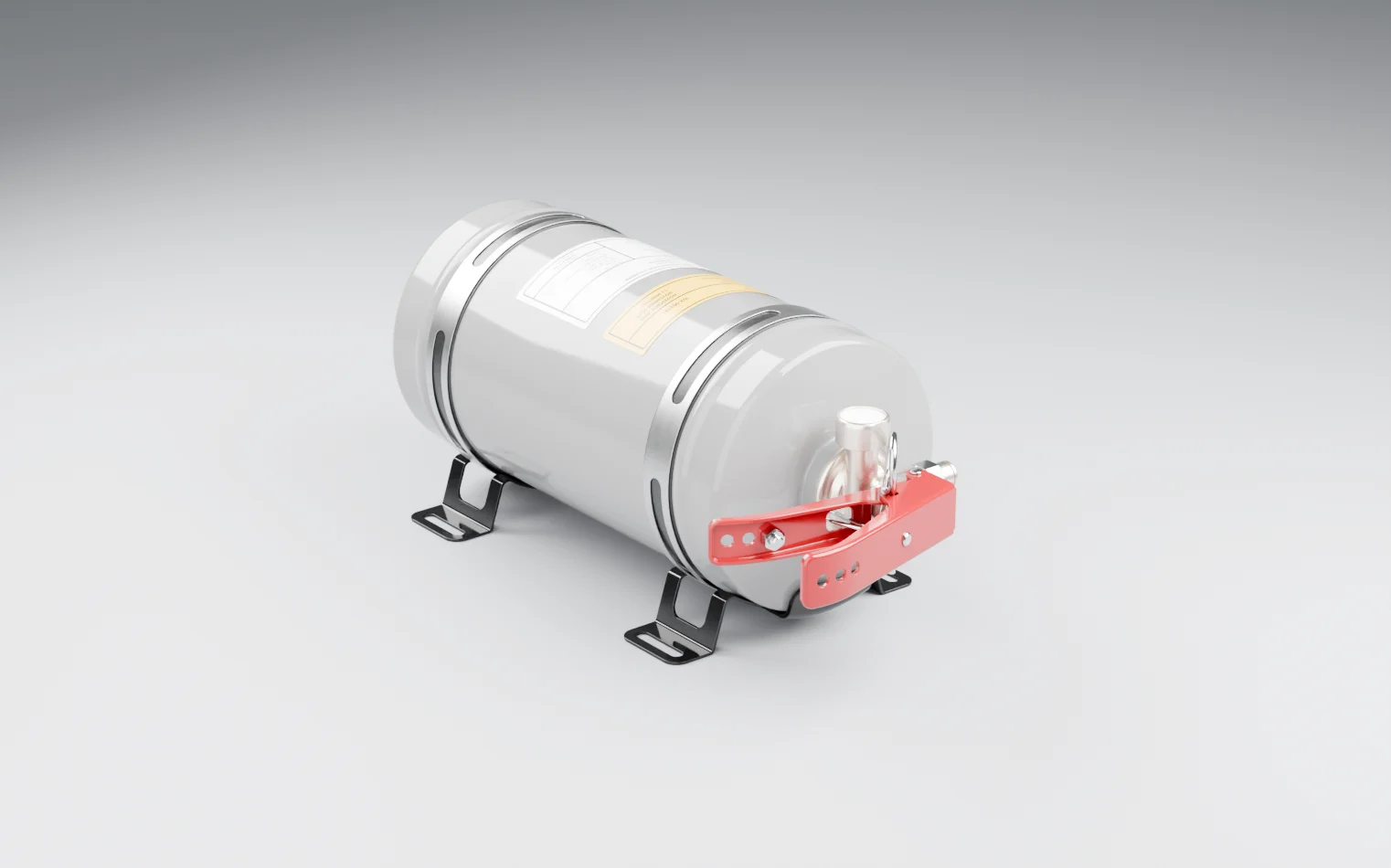
In service. Mounted, connected to its pipework and armed as the system's instructions require, with the gauge reading normal. Nothing happens until someone pulls the release.
Deviation library
Components
Explore the equipment
Hold an extinguishing agent under pressure, ready to discharge through fixed pipework onto a fire in a vehicle's engine bay or cockpit the moment someone pulls the release. This is a fixed bottle strapped into brackets, with a valve head carrying a pressure gauge, a safety pin and a red lever that a pull cable operates. The gauge means it is a stored-pressure unit: what it reads is the first thing anyone can check. It is vehicle equipment, not process plant, and carries no tags. The label carries a brand mark that came with the source model; it identifies nothing about this archetype and implies no affiliation. The model shows the cylinder and its valve head only — not the pull cable, the distribution pipework or the nozzles — and cannot tell you the agent it holds, its working pressure or its service and test dates. Read those from the cylinder's own label and its service record.
Components
Cylinder
The pressure vessel that holds the agent and its propellant, with its labels. A stored-pressure cylinder is under pressure all the time it is charged, not only when it discharges.
Normally: Charged, undented, free of corrosion and within its test date.
Valve head
The valve on the end of the cylinder, with the outlet the distribution pipework connects to. It holds the cylinder's pressure until the lever opens it, and it is the part most easily damaged by a knock or a fall.
Normally: Closed and leak-free, with the pipework connected to the outlet.
Pressure gauge
The gauge on the valve head, showing whether the stored pressure is in the range the cylinder needs to discharge fully.
Normally: Reading in its marked normal range, with the face clean and readable.
Release lever
The red lever on the valve head and its bracket. A pull cable from the driver's or a marshal's position moves it to open the valve.
Normally: Free to move, with its cable attached and nothing else bearing on it.
Safety pin
The pin and pull ring through the valve head that stop the lever operating while the cylinder is handled. Whether it stays in or comes out in service depends on the system's instructions, which is exactly why it is part of every check.
Normally: In the position the system's instructions require for the vehicle's current state.
Brackets and straps
The brackets, straps and their liners that hold the cylinder to the vehicle, and the fixings that hold them.
Normally: Tight, uncorroded and holding the cylinder without movement.
Operating states
Being fitted or serviced
The release is made safe before the cylinder is touched — the pin in, the cable disconnected — and the cylinder is carried by its body, not its valve head. Nobody loosens the valve or its fittings while it is pressurised.
In service
Mounted, connected to its pipework and armed as the system's instructions require, with the gauge reading normal. Nothing happens until someone pulls the release.
Released
The cable pulls the lever, the valve opens and the agent is driven out through the pipework to the nozzles until the cylinder is empty. The operator's job is already to stop, switch off and get out.
After a discharge
The cylinder is empty and the protected space is full of agent. It is ventilated and left until clear, the clean-up follows the agent's safety data sheet, and the vehicle stays out of service until the cylinder has been recharged or replaced and the reason for the discharge found.
Failure scenarios and safeguards
LESSStored pressure
The low reading is seen at a pre-use check and the cylinder is serviced before the vehicle is used.
Causes
- A slow leak at the valve seat or its seals
- A partial discharge that was not reported
- Damage to the valve head from a knock
How it develops
- 01Pressure escapes slowly through the valve or its seals.
- 02The gauge needle drops out of its normal range — the only outward sign.
- 03Released in a fire, a cylinder short of pressure discharges weakly or only part of its agent.
Safeguards
Gauge checked before use
The gauge is read as part of the vehicle's pre-use checks, and a reading outside its normal range takes the vehicle out of service until the cylinder is serviced.
If it fails: A cylinder that has lost its pressure stays in service looking ready.
Inspection and service by a competent person
The cylinder, its valve, its release and its pipework are inspected and serviced at the interval the manufacturer and local rules require: pressure or contents checked, the cylinder examined for damage and corrosion, test dates confirmed, and the release proved.
If it fails: The system's condition is unknown until the day it is needed.
Unmitigated: A system that releases but does not put the fire out, discovered during the fire.
NODischarge
A serviced, armed system discharges when released; and an operator who knows the system is only a delay is already getting out.
Causes
- Release left in its safe position after maintenance
- Release cable or actuator disconnected, seized or damaged
- Cylinder empty or below its working pressure after a slow leak or an unrecorded discharge
- Distribution pipework disconnected, crushed or blocked
- Safety pin left in where the system's instructions require it out
How it develops
- 01A fire starts and the system is triggered.
- 02The valve does not open, or it opens on a cylinder with too little left in it to discharge.
- 03No agent reaches the fire, and the fire grows while the operator waits for the system to work.
Safeguards
Inspection and service by a competent person
The cylinder, its valve, its release and its pipework are inspected and serviced at the interval the manufacturer and local rules require: pressure or contents checked, the cylinder examined for damage and corrosion, test dates confirmed, and the release proved.
If it fails: The system's condition is unknown until the day it is needed.
Release made safe for handling and maintenance
Before the cylinder is handled, removed or worked near, its release is made safe by the manufacturer's method — the safety pin in, the actuator disconnected — and nobody loosens the valve or its fittings on a pressurised cylinder. It is re-armed, and the arming checked, before the vehicle returns to service.
If it fails: A release knocked during work discharges the system, or a valve loosened under pressure lets go.
Pipework and nozzle checks
The distribution pipework and nozzles — not in the model — are checked as part of the service: connected, undamaged, routed clear of heat and moving parts, and with any nozzle caps in place so the outlets are not blocked by dirt.
If it fails: The agent leaves the cylinder and never reaches the fire.
Operator briefed on the release and the response
Whoever drives or operates the vehicle knows where the release is, when to use it, and what follows: stop, switch off, get out and away, and raise the alarm. The system buys time to escape; it is not a reason to stay.
If it fails: The release is not used, or is used and the operator stays with the vehicle.
Unmitigated: The fire develops unopposed in the engine bay or the protected space, with the operator still inside the vehicle relying on a system that did not work.
OTHER THANRelease
With the release made safe for the work, nothing discharges; if it does, the space is ventilated and left until it is clear.
Causes
- Release knocked or pulled while working near it, with the safety removed
- Cylinder dropped or struck while being handled armed
- Release cable snagged or tensioned by something else on the vehicle
How it develops
- 01The system is triggered with nobody expecting it.
- 02The cylinder discharges through its valve — into the protected space, or, if the pipework is off, straight out of the valve.
- 03A loose or unmounted cylinder discharging from an open outlet is driven by its own release and can move violently.
Safeguards
Release made safe for handling and maintenance
Before the cylinder is handled, removed or worked near, its release is made safe by the manufacturer's method — the safety pin in, the actuator disconnected — and nobody loosens the valve or its fittings on a pressurised cylinder. It is re-armed, and the arming checked, before the vehicle returns to service.
If it fails: A release knocked during work discharges the system, or a valve loosened under pressure lets go.
Secure mounting
The cylinder sits in the brackets and straps its manufacturer specifies, fixed to structure that can hold it under braking and in a collision, with the straps tight and nothing corroded or cracked.
If it fails: The cylinder works loose, chafes, or comes free in a collision.
Response after any discharge
After a discharge the space it went into is ventilated and left until it is clear, the agent's safety data sheet is followed for clean-up and exposure, and the vehicle stays out of service until the system has been recharged or replaced and the cause found.
If it fails: People breathe or handle the agent, or the vehicle goes back into service with an empty cylinder.
Unmitigated: Agent released into an occupied cab or a workshop, a startled person injured by a moving cylinder, and a vehicle with an empty system that nobody knows about.
OTHER THANMounting
Tight, sound mounting holds the cylinder where it was fitted through vibration and impact.
Causes
- Straps or brackets loose, corroded or cracked
- Cylinder refitted without its full set of fixings
- Mounting structure not strong enough for the cylinder in a collision
How it develops
- 01The cylinder is no longer held firmly; it shifts with vibration and chafes against its straps.
- 02In heavy braking or a collision it comes free, and the valve head — the weakest part of a pressurised cylinder — takes the blow.
Safeguards
Secure mounting
The cylinder sits in the brackets and straps its manufacturer specifies, fixed to structure that can hold it under braking and in a collision, with the straps tight and nothing corroded or cracked.
If it fails: The cylinder works loose, chafes, or comes free in a collision.
Inspection and service by a competent person
The cylinder, its valve, its release and its pipework are inspected and serviced at the interval the manufacturer and local rules require: pressure or contents checked, the cylinder examined for damage and corrosion, test dates confirmed, and the release proved.
If it fails: The system's condition is unknown until the day it is needed.
Unmitigated: A heavy cylinder loose in the vehicle in a crash, and a damaged valve on a pressurised cylinder that can release violently.