Stainless Steel IBC
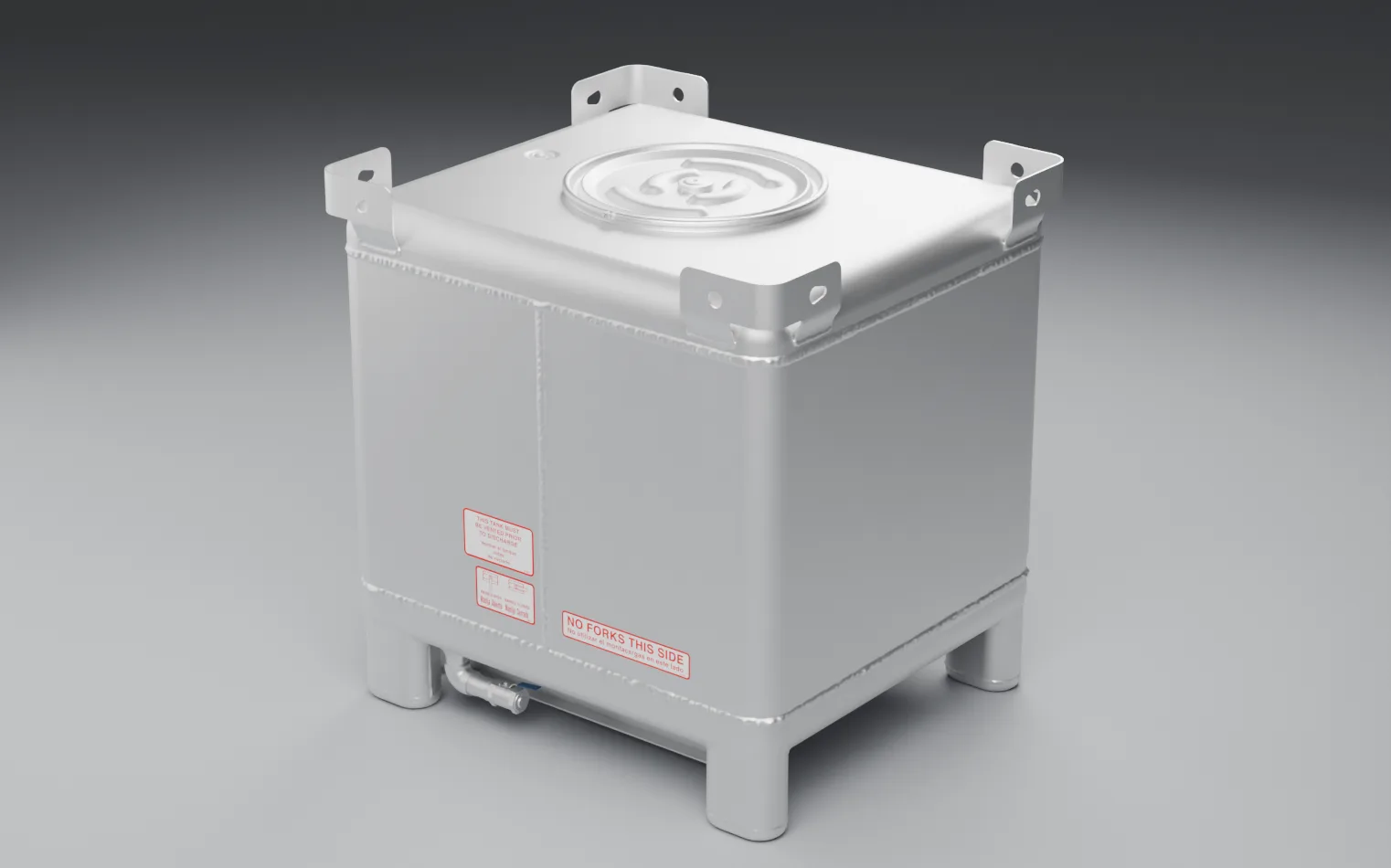
A stainless intermediate bulk container, showing vacuum on discharge, overfilling, a leaking outlet, forks on the wrong side and the wrong liquid in the tank.
Filling. The lid is opened and liquid goes in from the top. The filler watches the level and stops short of the top, leaving room for the liquid to expand. For a flammable liquid the tank and the filling equipment are earthed and bonded first.
Deviation library
Components
Explore the equipment
Hold, move and dispense a bulk liquid without losing any of it. A stainless intermediate bulk container is filled through the manway on top, lifted by forklift under its legs or by crane from its corner lugs, and emptied through the valve at the bottom. Its labels say two things that matter: the tank must be vented before it is discharged, and forks must not go in on the side with the outlet. The hazard depends entirely on what is inside — a corrosive, a flammable liquid, a toxic chemical or a harmless one — so the safety data sheet and the label of the contents, not the tank, decide the precautions. This is a portable container, not fixed plant, and carries no tags. The model is the empty container: it does not show its contents, its fill level, any pressure or vacuum relief, an earthing point, the pump or hose used to fill or empty it, or a spill bund, and its rated capacity and the loads its lugs are rated for are not given. Read those from its nameplate and its last inspection record.
Components
Tank shell
The welded stainless shell that holds the liquid. Stainless resists many chemicals but not all of them, and it is not built to take pressure or a vacuum.
Normally: Clean, undented and free of corrosion, with no weeping at the welds.
Manway lid and clamp ring
The lid on the opening in the top, held down by its clamp ring. The tank is filled and cleaned through it, and with it shut the tank is closed to the air.
Normally: Closed, clamped and sealed, with its seal in good condition.
Bottom outlet valve
The valve and spout low on the front face, through which the tank is emptied. It is the lowest point of the tank, so every litre above it depends on it to stay closed.
Normally: Closed, capped, and not dripping.
Legs and base frame
The four legs and the rails between them that carry the full weight of the tank and its contents, and that give a forklift room to get its forks underneath.
Normally: Square, undamaged, standing level on firm ground.
Corner lifting lugs
The four lugs at the top corners, used to lift the tank by crane with shackles and slings, and to locate one tank on another where stacking is allowed.
Normally: Undistorted and uncracked, used only with the lifting gear and loads the tank is rated for.
Warning labels
The labels on the shell. The model's say that the tank must be vented before it is discharged, that forks must not be used on the outlet side, and show how it may be lifted. The contents label and the data plate belong here too.
Normally: In place, legible, and matching what the tank actually holds.
Operating states
Stored, closed
The tank stands on firm, level ground, ideally in a bund, with the lid clamped, the outlet closed and capped, and a label that says what is in it.
Filling
The lid is opened and liquid goes in from the top. The filler watches the level and stops short of the top, leaving room for the liquid to expand. For a flammable liquid the tank and the filling equipment are earthed and bonded first.
Discharging
The tank is vented first, then the bottom valve is opened into a hose, a pump or a container. Air has to get in at the top as fast as liquid leaves at the bottom; if it cannot, the flow slows and the shell is pulled inwards.
Lifting and moving
The tank is lifted by forklift from a side without the outlet, or by crane from all four lugs with the right gear, with the lid and outlet closed. A full tank is heavy and its liquid moves, so it is lifted low and driven slowly.
Failure scenarios and safeguards
LESSPressure
The tank is vented before discharge and empties smoothly.
Causes
- Bottom valve opened without venting the tank first
- Lid clamped shut and its vent, if fitted, blocked
- Pumping out faster than air can get in
How it develops
- 01Liquid leaves at the bottom and nothing replaces it at the top.
- 02A vacuum builds. The flow slows and gurgles, and the flat panels of the shell are pulled inwards.
- 03Someone opens the lid to free the flow, and the air rushing in can splash the contents.
Safeguards
Vent before discharge
The tank is vented at the top before the bottom valve is opened, as its label says, and stays vented while it empties.
If it fails: The shell is pulled in by vacuum, or a tank under pressure sprays when it is opened.
Unmitigated: A buckled tank that has to be taken out of service, and splashing of the contents when it is opened.
MORELevel
Filling stops with room to spare, and anything that does spill is held in the bund.
Causes
- Filling left unattended
- Level misjudged through the manway
- Wrong volume ordered or transferred
- Liquid filled cold and then warmed
How it develops
- 01The liquid reaches the top of the tank with no room left to expand.
- 02It overflows at the manway and runs down the outside of the tank.
Safeguards
Attended filling with a level check
Filling is attended from start to finish, the level is checked as it rises and the fill stops with room left for expansion.
If it fails: Liquid comes out of the manway and down the sides of the tank.
Spill containment
Tanks of anything harmful are stood in a bund or on a spill pallet big enough to hold what could leak, and a spill kit suited to the contents is nearby.
If it fails: A leak spreads across the floor and into drains.
Unmitigated: A spill of the contents on to the tank, the floor and the person filling it.
OTHER THANContainment at the outlet
The valve is closed and capped, the drip is seen at the check before moving, and the bund holds what escapes.
Causes
- Valve left partly open after the last discharge
- Valve handle knocked open while the tank is moved
- Valve seal worn or attacked by the contents
- Cap missing, so a dripping valve runs freely
How it develops
- 01Liquid drips or runs from the outlet at the bottom of the tank.
- 02With the outlet at the lowest point, the whole contents can drain out while nobody is watching.
Safeguards
Outlet closed and capped when not in use
The bottom valve is closed and its cap fitted whenever the tank is not being emptied, and it is checked for drips before the tank is moved.
If it fails: A valve knocked open or left open empties the tank on to the floor.
Spill containment
Tanks of anything harmful are stood in a bund or on a spill pallet big enough to hold what could leak, and a spill kit suited to the contents is nearby.
If it fails: A leak spreads across the floor and into drains.
Periodic inspection and leak test
The tank, its valve, seals and lugs are inspected and leak-tested at the interval its approval and the transport rules require, and the date is marked on its plate.
If it fails: Corrosion, a cracked weld or a worn seal is found by a leak instead.
Unmitigated: Loss of the full contents, with exposure, slips, environmental release and, for a flammable liquid, a fire risk.
OTHER THANHandling
Forks go in from the allowed sides only, and the tank is lifted low with its outlet closed.
Causes
- Forks put in on the outlet side despite the label
- Forks too short or too narrow, or the tank lifted off-centre
- Crane lift from fewer than four lugs, or with the wrong gear
- Full tank driven fast or lifted high
How it develops
- 01Fork tips strike the outlet valve, or the tank sits unevenly on the forks.
- 02The valve is broken off or the shell punctured, or the load swings and the tank tips or falls.
Safeguards
Correct forklift and lifting practice
Forks go in only from the sides the label allows, and crane lifts use all four lugs with gear rated for the full tank. Drivers and slingers are trained and the tank is lifted with the lid and outlet closed.
If it fails: Forks hit the outlet valve, or the tank tips or drops.
Outlet closed and capped when not in use
The bottom valve is closed and its cap fitted whenever the tank is not being emptied, and it is checked for drips before the tank is moved.
If it fails: A valve knocked open or left open empties the tank on to the floor.
Spill containment
Tanks of anything harmful are stood in a bund or on a spill pallet big enough to hold what could leak, and a spill kit suited to the contents is nearby.
If it fails: A leak spreads across the floor and into drains.
Unmitigated: A sudden release of the full contents, and a dropped or overturned tank near people.
OTHER THANContents
The label and paperwork are checked, and a cleaned tank is used, before anything goes in.
Causes
- Tank not cleaned after its last use, so residue remains
- Old label left on, or no label at all
- Wrong tank picked for the transfer
- Liquid that attacks stainless steel or the valve seal put in
How it develops
- 01A liquid goes into a tank that holds, or held, something it reacts with.
- 02The mixture heats, gives off gas or builds pressure, or the contents slowly corrode the shell and seals.
Safeguards
Contents labelled and checked
The tank carries a label for what is in it, the label is checked against the paperwork before it is filled or emptied, and an old label is removed when the tank is cleaned.
If it fails: The wrong liquid is added or discharged, and nobody knows what they are handling.
Periodic inspection and leak test
The tank, its valve, seals and lugs are inspected and leak-tested at the interval its approval and the transport rules require, and the date is marked on its plate.
If it fails: Corrosion, a cracked weld or a worn seal is found by a leak instead.
Earthing and bonding for flammables
When the contents are flammable, the tank, the hose and the receiving container are earthed and bonded before any liquid moves, in an area suitable for flammable vapour.
If it fails: A static spark ignites the vapour at the manway or the outlet.
Unmitigated: A reaction inside the tank, a toxic or flammable release at the manway, or a leak through corroded steel.